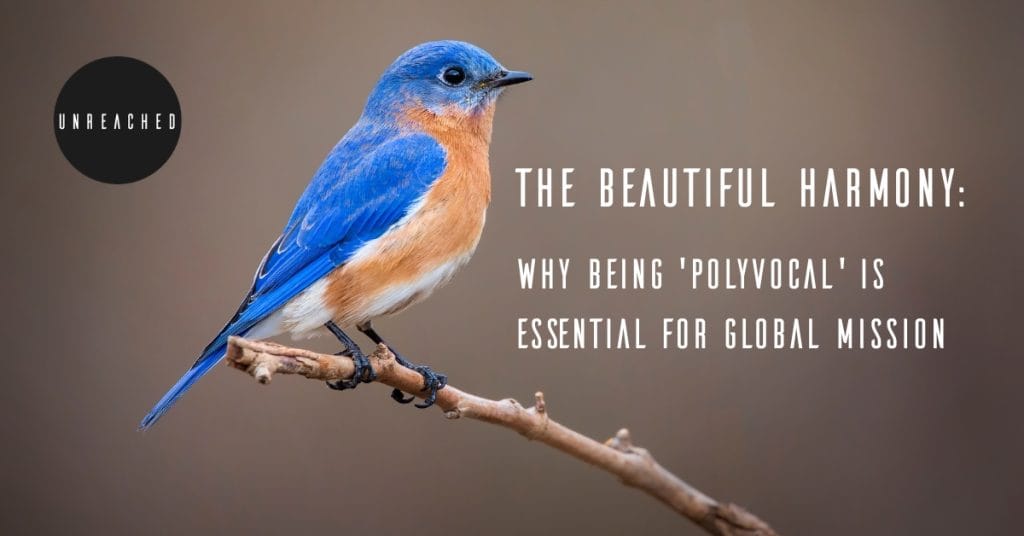
In this post we’re sharing a piece of the emerging vision for the Unreached Network, focusing on one of our core values: being ‘Polyvocal’. What does it mean to be ‘Polyvocal’? In short, it is our deep belief that the global church is meant to produce a “beautiful sound”—a harmony of multiple, distinct voices from every nation, culture, and background. Join us as we explore the biblical roots and practical necessity of deliberately embracing this power and beauty in diversity.
Why ‘Polyvocal’?
When we use the word ‘Polyvocal’, we’re tapping into the incredible mechanism found in many songbirds (though sadly not the hummingbird). The songbird’s voice box, the syrinx, has two independent passageways, allowing a single bird to produce two distinct pitches or melodies at the same time. It’s a literal, beautiful harmony.

In the global church, being ‘Polyvocal’ means deliberately welcoming multiple, simultaneous voices—from every culture, nation, and language. It means we cannot prefer one song, one expression of worship, one theological framework or one voice as “more right” than another. Instead, we must see the complementary nature of the sweet, diverse, creative, colourful, voices and cultures and expressions of lives lived out in worship to God.
Jesus’ Example: The Twelve
Jesus modeled this polyvocality from the very beginning when he chose his Twelve Disciples – this in itself was Jesus’ first masterclass in deliberately forging beauty from diversity, growth through the knocking off of rough edges, when we choose to be in close community with those who are not like us, united by our love for Jesus. (And yes, we still see this happening in the church today).
Let’s just consider these 2 disciples for a moment:
- Simon the Zealot: A political revolutionary, fiercely dedicated to overthrowing the Roman Empire. His ideology was one of armed resistance and deep anti-occupation sentiment.
- Matthew: A tax collector, a direct agent of the occupying Roman force. He was complicit in and benefited directly from the very system Simon was sworn to destroy.
Imagine the tension, the conflicting worldviews, the deep personal and political animosity in that room! And that’s just between those 2! Yet, Jesus intentionally put them in the mix together, along with 10 other very different people. Different personalities, backgrounds, temperaments, and ideologies—all learning to walk together under a unified front. All being taught by Jesus. Their unity was not based on shared politics, characteristics or cultural heritage, but on their shared commitment to the Son of God. And he made their unity beautiful.
Expanding the Vision: The 72 Nations
So how does this relate to global mission? In Luke 9:1-6, Jesus sends out these 12 in pairs. This is a diverse, but still mono-cultural group of men who are not just meant to express their unity in holy huddles, they are sent out and need to learn to work together to bring God’s kingdom to neighbouring towns and villages.
But then in Luke 10:1-4 – Jesus sends out the 72 (or 70 in some manuscripts). In doing so, he begins to reveal more of God’s global plan. The number 72 (or 70 in some manuscripts) is profoundly significant in Old Testament tradition, and particularly in the Septuagint translation of the Table of Nations. In Genesis 10, the number 70 or 72 represented “all the nations of the earth.” So reading Luke 10 in the context of the 72 representing all the nations of the earth, we read:
“After this the Lord appointed seventy-two others and sent them two by two ahead of him to every town and place where he was about to go. He told them, ‘The harvest is plentiful, but the workers are few. Ask the Lord of the harvest, therefore, to send out workers into his harvest field. Go! I am sending you out like lambs among wolves. Do not take a purse or bag or sandals; and do not greet anyone on the road.’”
Lessons from the 72
By sending out the 72, Jesus was not just preparing the Jewish towns for his arrival; he was symbolically enacting a universal mission, demonstrating some key things about God’s heart for polyvocal mission:
- The Mission is Global: Reaching the nations is supposed to take every nation reaching every nation, partnering together to see God’s kingdom fill the earth. The polyvocality of their personalities, languages, cultures and lived experiences are essential pre-requisites to their success, not optional. In our work, we’ve had the privilege of seeing this first hand – the beauty and unique expression of God that each culture brings, that is missing in other cultures, and that is needed to display the full glory of God when they come together. The Global church needs each other when outworking missiology, theology, worship, leadership, strategy, ecclesiology. We are not supposed to be competing voices, but complimentary pairings that make everything sound, taste, work and be better.
- Unity is Essential: The 72 had to overcome cultural, linguistic, and theological challenges to work together in unity as one family—anyone who has lived in close proximity to any other human being understands that although it’s hard at times, we all need each other. The kingdom of God is designed to advance and flourish in unity through diversity. The Psalmist writes in Psalm 133: “How good and pleasant it is when God’s people live together in unity!…it is there that the Lord commands his blessing.” And Jesus prays in John 17:23: “that they may be perfectly united, so that the world may know that You sent Me and have loved them just as You have loved Me.“
- The Method is Partnership and Provision: They were sent two by two, and like Lambs among Wolves, demonstrating the necessity for partnership and mutual accountability, dependence on each other, on prayer, the Holy Spirit, supernatural provision, protection and success.
The End Goal
The ultimate end-game polyvocal picture is found in Revelation 7:9: that’s what we are working towards. A great multitude from every nation, tribe, people and language, standing before the throne in worship.
Each person, each culture, and each language carries a unique expression that displays God’s glory. We are incomplete without each other. We need to learn from, be challenged by, and work alongside each other to see the fullest expression of God’s glory fill the earth as the waters cover the sea. To be ‘Polyvocal’ is not merely a nice ideology; it is an essential expression of the complete glory of God. It’s going to take some work, but it’s worth it. Let’s do this together!
Questions for Reflection
- What are some practical ways in which you can out work this value of ‘Polyvocality’ in your life, place of study, work or church community?
- Who could you intentionally seek out this week to genuinely listen to and learn from?

The Unreached Network exists to inspire and strengthen cross cultural mission to Unreached Peoples across the global Newfrontiers family.
We do this by training, resourcing, inspiring and creating spaces for network, with individuals, churches and spheres as they take responsibility for sending.
Want to partner with us? Get in touch at www.unreached.network/contact-us