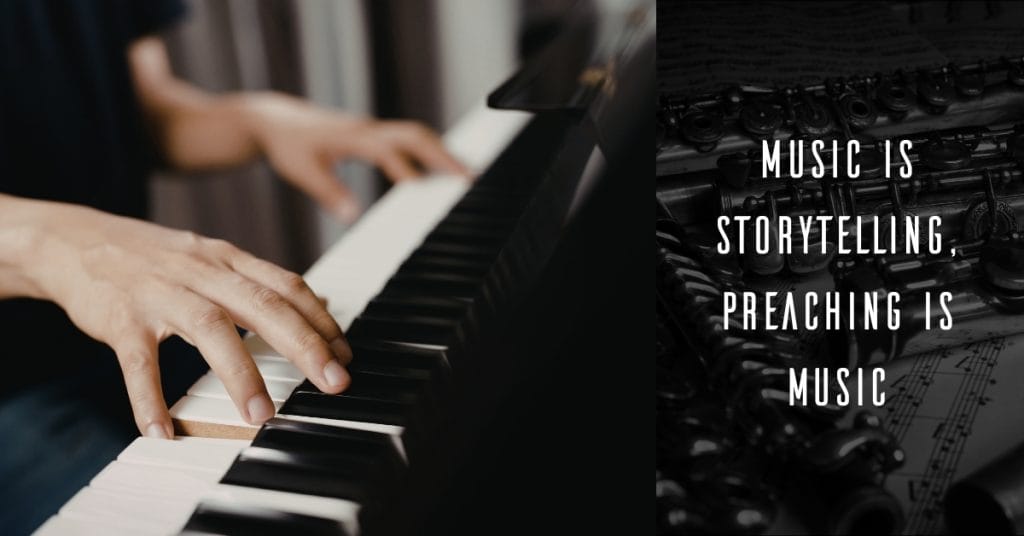
Preaching from the whole Bible is like playing music using the whole piano.
Penang island. 4am. Severely jet lagged. As I sit on my balcony, looking at the dark jungle and listening to the nightjars singing, I reflect; preaching from the whole Bible is like playing music using the whole piano.

Think of your Bible like a piano keyboard, with the left hand (bass) as the Old Testament, and the right hand (melody) as the New.
There are predictable, safe, pure major chords to be played. Take Isaiah 53:5, John 19:30, and 1 Peter 2:24 – the C major of Christ’s sacrificial death; prophetic promise, eyewitness testimony, and apostolic explanation. A major chord, bold and true.
But there are so many varieties of music! Don’t get stuck playing 3-note major chords – this keyboard has so much more to offer. Like a jazz chord – throw in a major 9th here and there for sweetness. Notes that don’t normally sit comfortably together suddenly make sense because there is movement towards resolution. The book of Revelation can add some top notes, overtones that keep on resonating long after you’ve taken your fingers off the keys. And the bass can be – should be – dynamic, as your left hand explores Genesis, the Psalms, the Prophets.
And then, don’t forget that the Bible is a global book, and different cultures take wildly differing approaches to music. Preaching cross-culturally, you might reach for notes you ordinarily ignore, discover fresh melodies, try out entirely new combinations.
Mongolian throat singing (khoomei) is an ancient exploration of the power of overtones. One continuous bass note drones on whilst higher resonances are explored. And I enjoy preaching in that style – for example, sitting in Genesis 2 whilst showing how Eden leads to the tabernacle, the temple, the promised land, the church, the new heavens and the new earth. Jesus is the new Adam, and the whole Bible is the story of the search for a suitable bride for him. During his deep sleep, he receives a wound in his side, and when he wakes from death, there is his bride, the church! Jesus is the gardener of the new creation, which is why on the first day of the week he rose and was mistaken for the gardener. The four rivers that flow from Eden show the mission of God out from his presence to the four corners of the globe, the same river Ezekiel saw, and which John sees again in Revelation 22. The precious stones hidden in the ground are the nations of the world, which will be represented on the high priest’s breastplate, and in the building of the Temple, and finally in the new Jerusalem, which is not complete without being built from all the nations (Rev 21:18-20). And on and on drones the bass note of Genesis 2, whilst we explore resonances and fulfilments, centered in Christ and worked out through the church, coming to a fulfilment in new creation.
Or Middle Eastern music, with its quarter tones (notes in between notes), minor keys, deep emotion, and rhythms which delay resolution for much longer than the Western ear might find comfortable.
Or Chinese melody, which is invariably much higher-pitched than some ears find comfortable – much further up the scale than many are used to playing.
Or African-American preaching, which is all about rhythm, and demands congregational involvement, call and response to fill out the harmonies.
Music is storytelling, and preaching is music. The Bible is a bigger instrument with more octaves in it than you can imagine. The Bible is hospitable to considerable diversity – of genres, of authors, of themes and ideas, which sometimes even seem, on the surface of things, to clash with one another. The Bible is for the whole world, and different combinations of different verses create unexpected turns of subtle, complex harmonies. Even sections that seem irreconcilable, which appear to be out of tune with one another, can be melded together to generate unforeseen beauty. As any musician will tell you, sometimes you just need to sit at the keyboard, crack your knuckles, close your eyes, and play from the heart without knowing where the music will lead you. So too with preaching.
Preaching cross-culturally requires listening and experimentation. It also demands hours of practice. Don’t just stick to the safe parts of the keyboard. Don’t just reproduce sermons from back home. As you listen – to the culture, to the church, to the kind of preaching which resonates with local hearts – so too will you learn to play in new styles. Your left hand will discover under-utilised Ecclesiastes or Nahum. Your right hand will notice fresh journeys through the Gospels. You will access new emotions, fresh revelation, and powerful cultural resonances. And yes, there is the discipline of study and research and reading and practice. The key point is, different hearts rise to different kinds of songs, different ears appreciate beauty in different ways, and different preachers can craft infinitely varied melodies from the same eight notes.
Music is storytelling, and preaching is music. We have a big Bible from which all manner of truth can be articulated. And as all things are resolved in Christ, so ensuring that Christ is the pivot, the focus, the harbour of your preaching will ensure resolution, life, peace, power and much fruit.

Andy was born and raised in Cyprus, is married to Jessica, who is South African, has four children who were born in London, and lived in Turkey from 2009-2016. He has a Master’s Degree in Contextual Theology with Mission from All Nations Christian College, and works as the Executive Lead for the Hummingbird Trust. He is passionate about cross-cultural church planting, and is involved in coaching and developing churches and leaders, mostly in the Eastern Mediterranean/West Asia region. He also leads the Unreached Network, facilitating best practice in cross-cultural mission across the wider Newfrontiers family. He is the author of four books on the Bible and mission.
Amazon Author Page: https://www.amazon.com/stores/author/B092W948PL/about