I have lived in the US for a year now, after four years of living in Greece. In Greece I was blessed to be connected to the Unreached Network. I completed three years of internships whilst volunteering for a Church plant serving, in the main, the refugee community in Athens as well as undertaking voluntary work with the Salvation Army.
Now in the US, I am asking who are the unreached here? How can I connect with them? How do I make it work here?
It sounds a silly question, in such a diverse country, built on migration and its many consequences. One might think the answer is not hard to articulate. However, I feel I ask a peculiar, silly question, but one I am seeking to ask and pray through every now and then.
The landscape
I may not reach the full answer, but I want to ask it anyway.
The country is vast and super-diverse so only seeing small bits of it, mean any sense I have of understanding it in a meaningful way are limited. Being from the UK the distances are difficult to comprehend.
Attempting to say I have a handle on the country, particularly after being here for just a year, would be equivalent to someone from the US living for a year in South Kensington and assuming they understood the UK – they would certainly have some insights, but would they understand the UK in its totality? Would they understand Newport, Stoke or Motherwell?
Back to the United States: are the unreached the African Americans? Well, they have made a huge and unique contribution to the shape and vibrancy of Church here, so maybe not. Consider the legacy of Azusa Street, a multi-racial congregation and the faith driven civil rights movement led by Dr King. This is an indelibly Christian legacy.
Are the unreached the indigenous/native Americans? Well, I need to tread carefully here, however and to the best of my knowledge and showing ignorance, I am not near any indigenous communities here and thankfully some people do present a faithful, contextual and relevant theology within that community. In fact, it is a sensitive area and a humble, truthful assessment of what mission in this context means is almost certainly impacted by the painful experience of the indigenous people here. Indigenous theology and mission are areas being explored in North America and I confess not knowing enough about this area to assume I can demonstrate any insight of note.
Are the unreached the many central American’s I see who do the labouring work in the affluent, white suburb I live in? I say hello in Spanish, read an English Spanish Bible but that is a puny effort really that has not born fruit yet. Latinos appear to be a real presence at the soccer team here, DC United. A phrase used by the fans is ‘Vamos United.’
From the aforementioned peoples and contexts, we could learn much.
However, thinking now about the dominant culture and those sections of the community who are explicitly not marginalised do we need to reflect a little more and make erroneous assumptions? I mean; are the unreached the white, secular liberals who live here? They may have moved here to the city I live in for work and have some affinity perhaps to a church, but I could still connect with and seek some impact? Some may be post-modern atheists and agnostics and therefore be a species of unreached. They are still a mission field and, in the West, a noticeable one.
Being a little controversial, might I suggest, are the unreached the Christian Nationalists who seem to have confused God’s Kingdom with the nation, actually unreached? In reaction to the excesses of secular-liberalism they appear to have embraced a fusion of Christian faith, mixed with something else. An easy thing to do, and all of us to some degree do that, as we live our faith out in the context of who are and where we are. Some are more contextual than others.
Some are seeking to lovingly reach out to their tribe and say, hey, there is another way. However, where I live, I don’t meet many Christian Nationalists and when I travel to different parts of the US, the loveliest Christians probably have a different political outlook to me. It is a little disorientating.
How now do we live and pray?
So, what do I do?
I know I overthink.
I pray, who are the Unreached? What can I do?
Parts of my life are ‘unreached’, I need more of Christ’s character.
I miss the UN prayer meetings, but they are at early o clock. I did attend the recent conference as I am determined to stay within the community.
Small steps of course are important. I talk to some guys in the local shop and coffee shop, (one works at both) mainly about soccer, one from the Middle East and one from Africa. Can I pray to get to know them and share my faith with them?
I try and read my English Spanish Bible.
I can look for signs, my pastor (at a Presbyterian Church) said he wanted the Church to look like the rest of DC…interesting I thought. That would mean less white and less middle-class in my reckoning.
I need to find likeminded souls. We are primarily the Body before we are individuals (1 Corinthians 12).
I cannot do this on my own. Please pray for me.
I

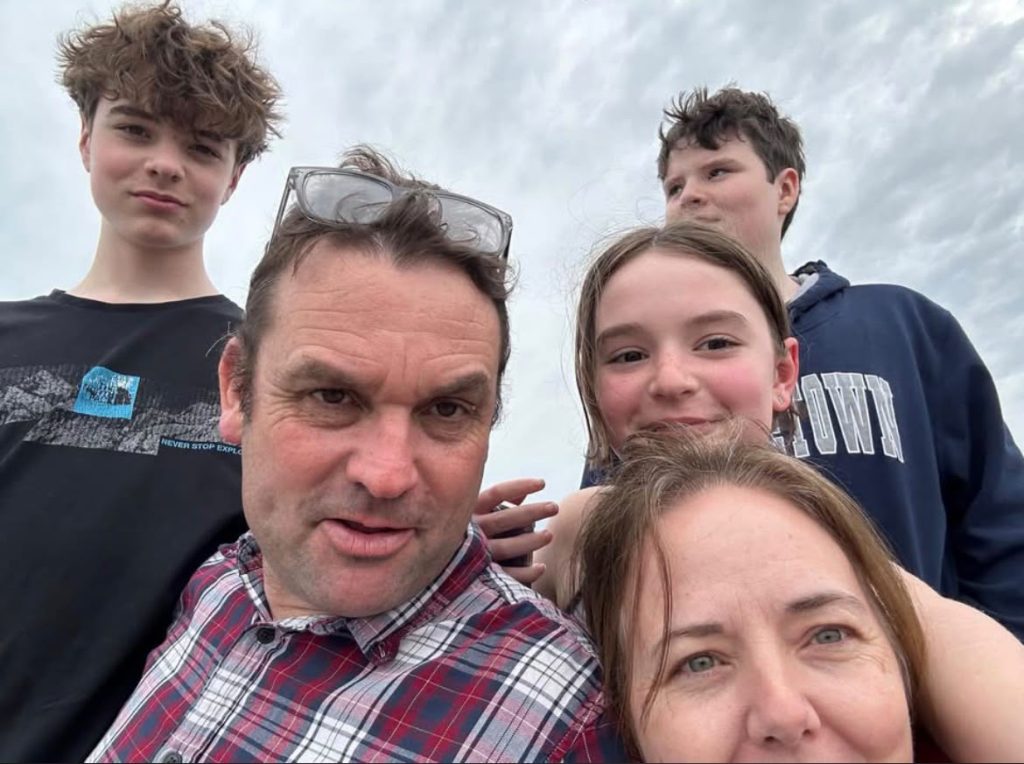
Ian Geary is from the Midlands originally has lived in the United States since 2025 with his Wife, three children, a dog and the recent addition of two kittens. Ian loves curry, supports West Bromwich Albion and enjoys reading and being with his family. He attends National Presbyterian Church and is on the NWDC Committee for Younglife, a Christian youth ministry. He says he supports the New England Patriots and the Boston Sox but is an armchair fan!
Before moving to the US, Ian and the family lived in Greece. In Greece he was greatly blessed to be an intern on the Unreached Network programme and a church plant serving the refugee community in Athens. he also re-connected with The Salvation Army there.
Ian is studying a part-time PhD at the University of Aberdeen in Divinity (Theology). In Greece, he volunteered with a multi-cultural Church planting initiative and assisted The Salvation Army in Greece with their social media. In DC he is continuing his Doctoral studies and seeking part-time work. He also helps Younglife DC in a voluntary capacity.
In the UK, Ian Geary worked as Public Affairs Adviser for the Salvation Army. He previously worked in Parliament for Rt Hon Sir Stephen Timms MP, Labour MP for East Ham, (London) and who was Labour’s Shadow Minister for Employment up to September 2015. He also worked from 1998 to 2000 for the late Rt Hon Bruce George MP, Labour MP for Walsall South (West Midlands) who was Chair of the House of Commons Defence Select Committee.
He has been a Labour party member for many a year, having worked for AEEU and Amicus trade unions and two public affairs consultancies. Ian stood for Parliament for the Labour Party in 2001 in Aldridge-Brownhills, in the West Midlands, which included his hometown. He has stood for council twice.
Ian served on the Christian Socialist Movement/Christians on the Left Executive from 2010 to 2015 and helped in the development of the Labour Neighbours Project and Christians in Politics engagement with Theological Colleges.
He has a BA (Hons) in Politics and Religion from the University of Manchester and MA (Econ) in Labour Studies also from the University of Manchester.
Ian co-edited an essay collection published in 2015 on Labour politics and his essay collection ‘Faith, Politics and Belonging’ was published on 19 July 2024 by Wipf and Stock. (a US publisher).